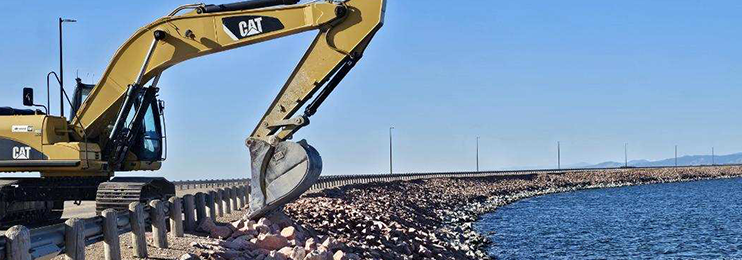
On a clear day, the dam at Rawhide Energy Station looks steady, stands firm above the sloshing water below.
Water stretches out along the shoreline. A gravel road runs along the top. From a distance, it’s easy to miss the fact that this structure is constantly being checked, evaluated and improved.
Occasionally, that behind-the-scenes work becomes visible. Like the day an excavator rolled out along the edge of the reservoir, ever so carefully placing large pieces of rock along the waterline.
If you stood nearby, you would see a tracked excavator reaching down toward the water, lifting and placing heavy, angular stone. Piece by piece, a layer begins to take shape along the dam's slope.
This rock layer, called riprap, might not look like much at first glance. It’s rough, uneven and built to blend into the landscape.
Winds sweeping across the reservoir cause waves to rise and push against the dam, and over time, this repeated force can wear away the soil.
The riprap absorbs that energy.
Instead of water wearing away the surface, it meets a barrier of durable rock designed to stay in place. This seemingly simple solution is critical to protecting the dam's outer layer from erosion and scouring.
Projects like this never happen by accident. They are crafted thoughtfully through studies and long-term planning that ultimately shape Platte River's safety culture.
Subject matter experts such as Brett Johnson, supervisor of plant chemistry, use a process called a Comprehensive Dam Safety Evaluation (CDSE). This collaborative study, conducted with our state dam engineer and consulting firm AECOM, gives our team a chance to pause and ask the questions that matter most: What could happen over time? What should we watch for? And where can we strengthen the system today?
The evaluation of the dam at Rawhide examined dozens of scenarios. Most were found to be highly unlikely, thanks to strong design, quality materials and consistent monitoring.
The evaluation reinforced a daily mantra for many Platte River employees: even when risks are low, maintenance matters.
One of the many scenarios reviewed in the CDSE considered the role of erosion. While the dam’s internal materials are designed to resist erosion, protecting the outer surface helps ensure small issues never have the chance to fester.
So rather than waiting for visible damage, our crews take action early. They reinforce and maintain the system, building in another layer of resilience.
The majority of monitoring is done through instruments inside the dam, measuring water level on the downslope-side and through routine inspections where trained eyes look for subtle changes. Our experts have plans that outline exactly what to do if something doesn’t look right.
Projects like the riprap installation are working parts of a much larger system designed to keep power flowing smoothly to our four owner communities. Even something as straightforward as placing rock along the shoreline plays a role.
Infrastructure safety isn’t built in a single moment. It’s built over time, layer by layer, just like the riprap that protects it.