Interview with: Brant Duncan, Brett Johnson, Jacen Kamtz, Everitt Pettit, Danielle Sosa, Albert Rodriguez-Caro
It was a mystery, a wet road on a bone-dry summer weekend at Rawhide Energy Station. Operations staff noticed that the main road into the plant appeared to be wet, without any recent rain. By Monday, the situation had grown stranger—large patches of ground along the road were like a waterbed, soft and bubbling underfoot. With heavy trucks driving the road every day, the team was concerned about a potential sinkhole.
The mystery of the suddenly gelatinous road traced back to a fire water pipeline, the very system that protects Unit 1 in an emergency. With the plant running at Generation Level 2 on sweltering 90-degree days, every megawatt was needed to keep our owner communities powered. Shutting things down wasn’t an option. As the situation grew murkier, the team discovered the decades-old valves meant to isolate the line wouldn’t fully close, leaving water seeping into the ground. Beneath the surface, the risks piled up: unstable soil, the chance of a sinkhole and even the possibility of tripping Unit 1 itself.
Outside contractors, specializing in excavations hesitated to take the job, worried about unstable ground and the unknowns beneath the surface. That’s when Rob Martin, supervisor of fuels and fleet, said, “Get Jacen Kamtz. We will do this ourselves.”
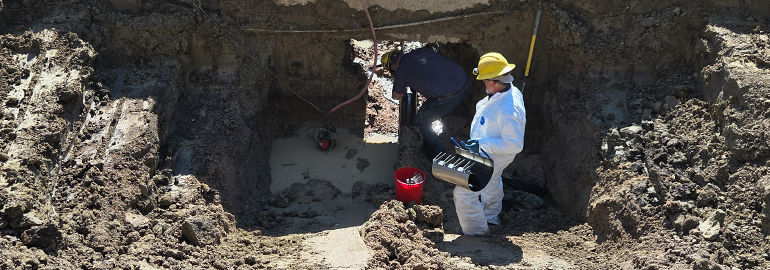
Jacen, fuel handling operator, brought extensive excavation knowledge and familiarity with the area’s underground layout. He led the crew to carefully carve out a 20-by-20-foot section of earth to reach the damaged pipe.
At Rawhide, rain began to pour, mud thickened and water continued to leak, but the team pressed on with patience and caution. Just a week earlier, a company-wide safety meeting featured Eric Giguere’s personal story of how he was buried alive while working in a trench. Proper shoring and sloping techniques made the excavation safe. Tight coordination across operations, maintenance, fuels, engineering, safety and the water lab kept the project moving forward.
In just a day and a half of digging, the crew exposed the damaged pipe and prepared it for repair. They installed a stainless-steel sleeve designed to withstand pressures well above the system’s normal operating levels. While typical municipal water pressure is around 90 PSI, Rawhide’s fire water system runs at an average of 150 PSI—meaning the team managed high-pressure water the entire time. With careful flow control and precise installation, they safely stopped the leak, ensuring both the pipeline and the surrounding area remained secure.
The repair was more than a technical fix. It was a testament to Platte River’s safety culture of choosing to slow down, think it through and do it right.
As Safety Manager Brant Duncan says, “Good enough doesn’t exist at Platte River.”
For Jacen, the job was personal: “I took it serious. I’ve been buried up to my chest before in a construction job. I didn’t want that to happen to anyone else.”
What began as a bubbling stretch of road became Rawhide’s largest excavation to date. This complex, high-risk challenge reminds us that safety isn’t just a protocol—it’s a mindset. At Platte River, it’s how we protect each other, our infrastructure and our owner communities.