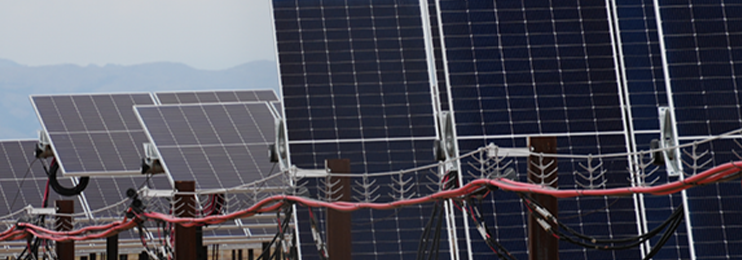
To most people, Black Hollow Sun (BHS) is a sea of solar panels stretching across the landscape visible from Highway 14.
To those who worked on it, it's the result of years of planning, problem-solving and perseverance.
The recent ribbon-cutting for BHS Phase II celebrated more than the completion of northern Colorado's largest solar array. It marked the culmination of an effort that touched nearly every department across Platte River and helped advance our noncarbon energy goals.
The project behind the scenes
Long before the first panel was installed, Platte River teams were determining whether a project of this size could work and how it could fit into the future energy system.
The process attracted significant interest. More than 50 developers responded to Platte River's request for proposals, resulting in more than 25 project submissions.
"Platte River experts analyzed costs, locations, transmission impacts, interconnection requirements, project schedules and developer experience before narrowing the field," said Masood Ahmad, senior manager of resource planning.
The BHS proposal ultimately stood out because of its competitive cost, strategic location and ability to connect efficiently to Platte River's transmission system.
Before it was built
As plans evolved, engineers revisited transmission impacts, interconnection options and the location of key facilities. What initially appeared to be the best solution evolved as teams identified opportunities to better position the project for future growth.
"The resulting decision required additional land negotiations, revised project planning and renewed coordination with landowners and the solar developer," said Daniel Daneshka, system electrical engineer.
That work led to the development of Severance Substation, designed not only to support BHS but also future resources, including battery storage and potential transmission interconnections. The planning required years of studies, permitting, easement negotiations, land acquisition and equipment procurement before construction ever began.
More than panels
Teams from resource planning, engineering, transmission operations, legal, finance, purchasing and contracts, communications and other departments worked together throughout the project's development.
"It makes you appreciate all of the different roles here at Platte River," said Mark Siano, supervisor of system engineering design.
That collaboration proved especially important as the project faced permitting requirements, changing market conditions, supply chain disruptions and equipment delays. The project also benefited from the leadership of Pat Connors, former director of portfolio strategy and integration, and the expertise of employees across the organization.
Building the grid of the future
Some of the most challenging work happened in areas few people ever see.
Today's solar facilities are expected to do much more than generate electricity. As renewable resources become a larger part of the grid, they must also help support system reliability through functions such as voltage regulation and frequency response.
"Integrating those capabilities required extensive modeling, testing and collaboration among project developers, owners and utility engineers," said Michael Cabida, operations engineer II.
Project teams had to carefully balance technical reliability requirements with project economics, all while coordinating with developers and industry organizations.
The real celebration
Under favorable conditions, the facility can generate enough electricity to meet the historical peak demand of both Longmont and Estes Park simultaneously, with capacity to spare.
But for many employees, the project's significance isn't measured in megawatts. It's measured in the countless hours spent solving problems, building partnerships and working across departments to bring a complex vision to life. For those who spent years on the project, a drive past BHS isn't just a view of solar panels. It's a reminder that some of the most important work happens long before a ribbon is cut.